
What makes it special
Tanzania / Serengeti & Zanzibar
Migration routes, then the Indian Ocean.
The plains south of Seronera are almost treeless, and the reason is volcanic. Ash blown east from the Ngorongoro highlands set into a hardpan that tree roots cannot break, leaving short grass on soil rich enough in calcium and phosphorus that more than a million animals return to calve on it every February. Serengeti National Park covers some 14,750 square kilometres of it, running north to the Kenyan border, where it continues unfenced into the Maasai Mara. The name is the Maasai siringet: the place where the land runs on forever.
Protection began in 1929, when the colonial administration of Tanganyika gazetted a game reserve here to stop the lion hunting that had become a trade. It became a national park in 1951, the country's first. In 1959 the Ngorongoro Conservation Area was split off by ordinance, creating the multiple-use area where Maasai still graze cattle among wildlife, and Bernhard Grzimek published Serengeti Shall Not Die. UNESCO inscribed Ngorongoro in 1979, the park in 1981.
Cut into the Conservation Area is Oldupai Gorge, 48 kilometres long and up to 90 metres deep, where Mary Leakey found the Paranthropus boisei skull in July 1959 and her son Jonathan the Homo habilis type specimen a year later. Few safari itineraries pass this close to the beginning of the human record.
The Serengeti and the migration
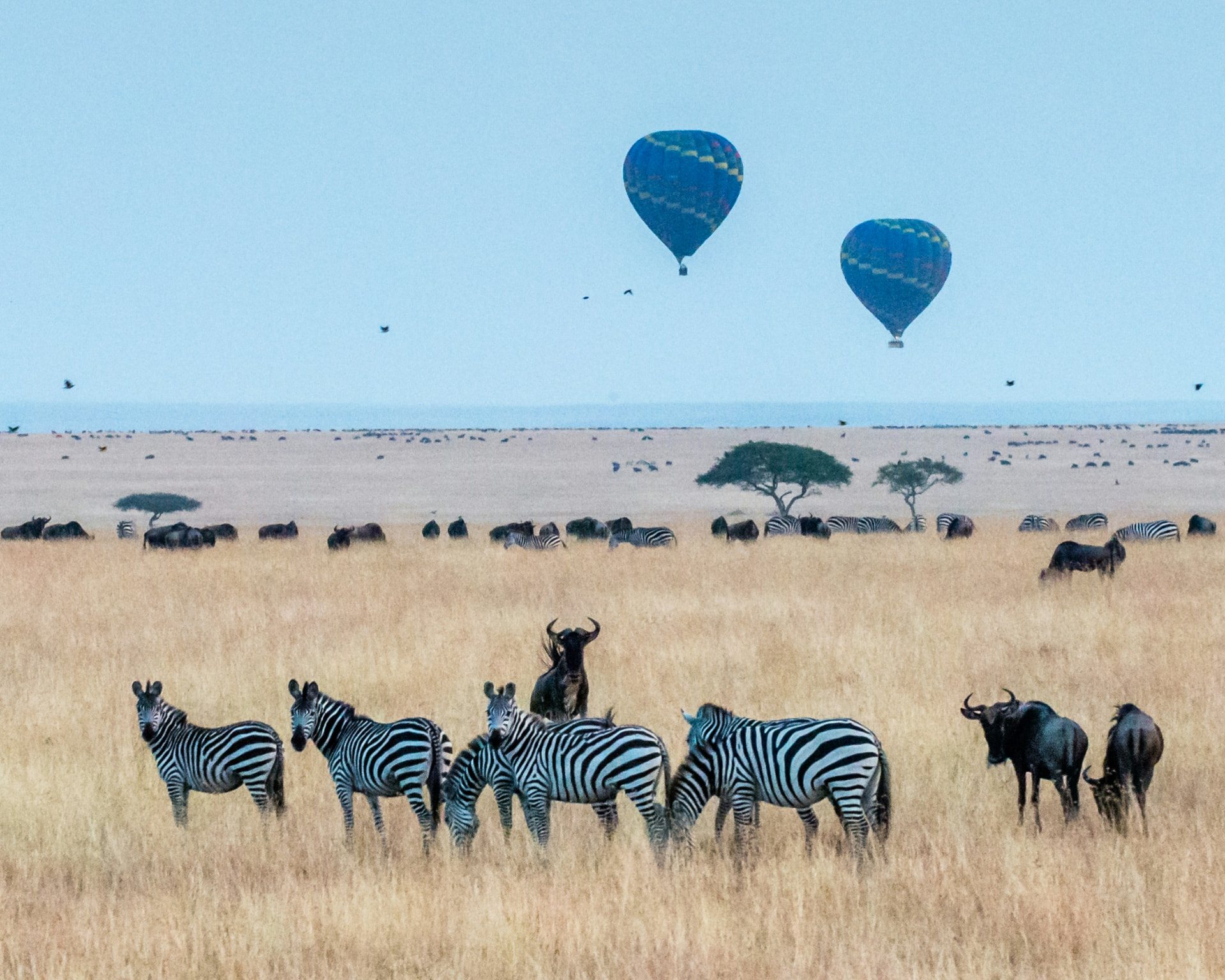
The migration is not an event with a date. It is a roughly 800-kilometre circuit that never stops, carried by about 1.5 million wildebeest with some 250,000 zebra and several hundred thousand gazelle. January to March the herds are on the southern short-grass plains around Ndutu, calving peaking in February at more than 8,000 calves a day. April and May bring the rut and a slow move north-west. May into July they funnel through the Western Corridor and cross the Grumeti. July to October they work the Mara River in the north around Kogatende. The short rains in November pull them south, and by December they are back on the plains.
Ngorongoro and the northern circuit — extraordinary, and genuinely busy
The crater is a caldera left when a volcano collapsed two to three million years ago: a floor of about 260 square kilometres inside walls some 600 metres high, holding an estimated 25,000 large animals that mostly do not leave. It is the most reliable black rhino ground in the country, around 55 animals in 2018, and delivers the Big Five inside a morning. It is also the busiest game-viewing ground in Tanzania: permits run six hours on the floor and in high season a lion can draw twenty vehicles.
Tarangire and Manyara — one is a base, one is a stop
Tarangire, 2,850 square kilometres proclaimed in 1970 and under two hours south of Arusha on tar, is the circuit's most underrated park. From June to October, as the surrounding Maasai steppe dries, elephant, zebra and buffalo concentrate on the Tarangire River in numbers that rival anywhere in East Africa, among baobabs that give the photography a character the Serengeti does not have. Two nights in the dry season, placed first in the routing; in the green months the game disperses.
Lake Manyara is small — 325 square kilometres, of which the lake is roughly 230 — with groundwater forest below a Rift escarpment. It has flamingos when water levels suit and a reputation for tree-climbing lions, which are seen far less often than the marketing suggests. A half-day on the drive from Arusha to the crater, not a two-night base.
The southern circuit — Nyerere and Ruaha
Nyerere National Park was carved in 2019 out of the northern third of the Selous Game Reserve, a UNESCO site since 1982, and at 30,893 square kilometres it is the largest park in Tanzania. The Rufiji River makes it: boat safaris through the lakes and channels, walking safaris and fly-camping, and one of Africa's more substantial wild dog populations. Ruaha, some 20,226 square kilometres, sits west on the Great Ruaha River with very large lion prides across baobab and miombo. Both are dry-season parks, June to October, many camps closed through the long rains — a second safari, not a first.
Kilimanjaro — a separate holiday
Uhuru Peak stands at 5,895 metres, the highest point in Africa and the highest free-standing mountain in the world, a dormant volcano of three cones — Kibo, Mawenzi at 5,149 metres and Shira at 4,005. Hans Meyer and Ludwig Purtscheller summited on 6 October 1889 with the Chagga guide Yohani Kinyala Lauwo; the park was gazetted in 1973 and inscribed by UNESCO in 1987. No technical skill is required, and that is the trap: success is a function of days on the mountain, not fitness. Sell Machame over seven days or Lemosho over eight, with the nine-day Northern Circuit the highest-percentage climb of all.
Zanzibar and the islands
Stone Town, on Unguja, was inscribed by UNESCO in 2000. Said bin Sultan moved the Omani capital here from Muscat in 1840 and planted the clove estates that still scent Pemba; the same port ran one of the Indian Ocean's largest slave markets until the treaty of 1873 closed it, and an Anglican cathedral stands on the site. The Old Fort dates from 1699, the House of Wonders from 1883. On 27 August 1896 the Royal Navy shelled the palace for about 38 minutes — the shortest war on record. Freddie Mercury was born here in 1946.
Then match the coast to the client. Nungwi and Kendwa in the north swim through the tidal cycle and hold the highest-end resorts. Matemwe on the north-east faces Mnemba Atoll three kilometres offshore, a protected reef of roughly seven by four kilometres and the best diving on the island. Paje and Jambiani on the east are the kitesurfing coast, younger and better value. Pemba, 50 kilometres north, is quieter and ringed by wall dives; Mafia, 120 kilometres south, has whale sharks inshore from roughly October to March.
The east coast carries a tidal range of three to four metres. At spring low the sea withdraws far past exposed reef and seaweed farms and swimming is simply not possible for part of every day.