
What makes it special
Rovos Rail
Southern Africa by classic rail.
Rovos Rail is the one entry in this collection that is not a destination. It is a moving hotel of 36 suites and a maximum of 72 guests, crossing as many as five countries on a single itinerary. Clients do not go to Rovos Rail. They travel on it, between the places they were going anyway, and that distinction should shape every conversation about it.
Rohan Vos bought his first coaches at auction in 1985, intending to hitch them to scheduled trains for family holidays. South African Railways declined, so he ran his own. The first commercial departure left on 29 April 1989 with one locomotive, seven carriages and four paying passengers, bound for the Eastern Transvaal Lowveld. Pretoria to Cape Town followed in 1991. The company is still owned and run by the Vos family, and the locomotives carry family names: Bianca, Brenda, Tiffany, Shaun, Marjorie.
The engineering base explains why the product exists. Rovos leased Capital Park in Pretoria in 1999, starting at about 12 acres and expanding to roughly 60. It is a working railway yard — restoration sheds, a loco shed completed in 2008, kitchens, laundries, a signal box and a rail museum — employing more than 430 people. Thirty-eight redundant South African Railways carriages were rebuilt from the frames up, and the oldest steam locomotive in the fleet was built by Dübs and Company of Glasgow in 1893. This is not a reproduction of a period train. It is one, kept alive by its own workshop.
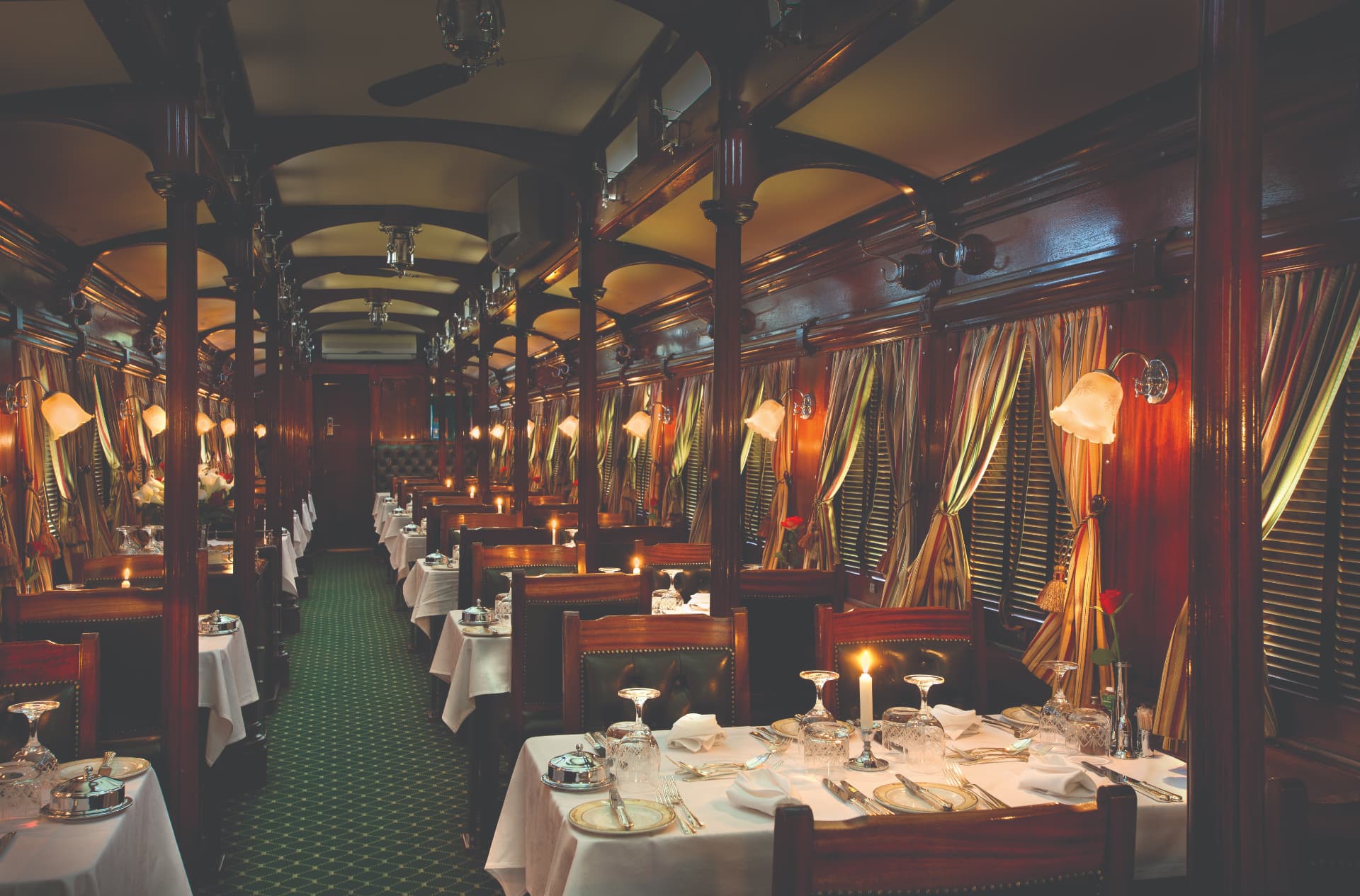
On board the offer is deliberately narrow. Suites come in three sizes: Pullman at roughly 7 square metres, Deluxe at 10, and the Royal at 16 with a Victorian bath as well as a shower. There is an observation car of about 32 seats with an open rear balcony, two dining cars seating around 42, and a lounge for 26. No televisions, no wifi; phones and laptops are confined to suites, and it is enforced. Dinner is formal — collar and tie mandatory for men, jacket optional. Fares cover meals, all beverages, room service, limited laundry, excursions and entrance fees. The Blue Train, the obvious comparison, runs a modern air-suspended consist on essentially one two-night Pretoria–Cape Town route, permits devices throughout and costs less. Send the connected client there; send the client who wants the 1930s to Rovos.
Pretoria to Cape Town — three nights route
The classic, and the one that converts. Three nights and 1,600 kilometres, both directions, year-round. First stop is Kimberley for the Big Hole, worked from 1871 to 1914 and dug largely by hand to 240 metres by a workforce that reached 50,000. Day two is the Great Karoo, ending at Matjiesfontein, the Victorian railway village built up by the Scot James Logan around an 1878 station and declared a national monument in 1975. The last run descends the Hex River Valley into the Winelands. Three nights is long enough to understand the train and short enough that a client who dislikes it has not lost a week — and it removes a domestic flight between Johannesburg and Cape Town.
Pretoria to Victoria Falls — three or four nights
1,400 kilometres north across the Tropic of Capricorn and the Limpopo into Zimbabwe, with Bulawayo, capital of Matabeleland, as the anchor. The four-night version adds Matobo National Park, a UNESCO site of granite whalebacks, San rock art and Cecil Rhodes's grave on Malindidzimu. Both include a Hwange game drive, and the route takes in 114 kilometres of dead-straight track. Guests disembark at Victoria Falls, where the 1905 bridge — a 156.5-metre arch 128 metres above the Zambezi, built for Rhodes's Cape-to-Cairo scheme — remains the only rail link to Zambia.
Pretoria to Durban — two nights, summer only
The short one: 800 kilometres, summer departures only, with a game drive at the Nambiti Conservancy, a Big Five private reserve of some 20,000 acres in malaria-free KwaZulu-Natal, a battlefields tour with a historian, Ardmore Ceramics in the Midlands and the Valley of a Thousand Hills on the descent. Two nights is a taste rather than a journey, and it suits the client testing the train before committing. Note the seasonality: it does not run in winter, when most safari clients travel.
Namibia Safari — eleven nights, Pretoria to the Atlantic
Eleven nights and 3,400 kilometres, Pretoria to Walvis Bay, either direction. Kimberley, then the Northern Cape, Fish River Canyon, the quiver-tree forest at Garas Park, the Kalahari and Windhoek. Guests fly from the train to Sossusvlei in the Namib, and the route also takes in Etosha, the diamond ghost town of Kolmanskop, Lüderitz and Swakopmund. It is the best-value long itinerary in the range because the train solves Namibia's central problem, distance: what is normally a punishing self-drive becomes a sequence of overnight runs.
Cape Town to Dar es Salaam — sixteen nights, the long one
5,530 kilometres and five countries: South Africa, Botswana, Zimbabwe, Zambia and Tanzania. Fifteen nights historically, sixteen from 2026, the extra night bought to ease the Zambia–Tanzania border. Matjiesfontein and Kimberley on the way up, two nights at Madikwe, the Victoria Falls Hotel, then the TAZARA line through the Udzungwa Mountains and Nyerere National Park to the Indian Ocean. Departures are quarterly at best. It suits semi-retired travellers with real flexibility, rail enthusiasts and repeat clients — emphatically not a first Africa trip. The northern half runs on infrastructure Rovos does not control, so build in two spare days.
The long specials — Collage, Southern Cross, Golf Safari, Copper Trail
Four itineraries run on limited annual dates. African Collage is twelve nights and 3,700 kilometres, Pretoria to Cape Town the long way through Kruger, eSwatini, Durban, Addo and Fancourt. Southern Cross is eleven nights and 2,500 kilometres, Pretoria to Victoria Falls via the Panorama Route, Maputo and Great Zimbabwe. Golf Safari is nine nights, a Pretoria round trip with a parallel non-golfing programme. The Copper Trail runs fourteen nights from Victoria Falls to Lobito in Angola, through Zambia and the DRC, with three nights in South Luangwa. One correction for the trade: the Trail of Two Oceans is the Dar es Salaam to Lobito crossing, Indian to Atlantic, not the Cape Town route.