
What makes it special
Botswana & Okavango Delta
Water, islands and low-density concessions.
The Okavango does what almost no great river does: it never reaches the sea. It rises in the highlands of central Angola, runs some 1,600 kilometres south-east across the Caprivi, crosses into Botswana and stops, spilling onto a tectonic trough in the northern Kalahari and fanning into channels, lagoons and palm islands. Around 6,000 square kilometres is permanent swamp; at full flood it swells to roughly 15,000. Some 11 cubic kilometres of water arrive each year and virtually all of it evaporates.
The rain that fills the Delta falls in Angola between December and February, reaches the northern Panhandle a month or so later, then pushes south through hundreds of kilometres of nearly flat channel at walking pace. The flood peaks between June and August, the middle of Botswana's dry winter. The Delta is at its wettest exactly when the surrounding Kalahari is at its driest, and that mismatch is the engine of the place.
The BaTawana controlled the Delta by the 1850s and in 1963, three years before independence, proclaimed Moremi Game Reserve on their own tribal land, driven largely by Elizabeth Pulane Moremi, widow of Chief Moremi III. It is generally credited as the first protected area in Africa created by a local community rather than a colonial administration. The Delta became a Ramsar wetland in 1996 and was inscribed by UNESCO on 22 June 2014 — the thousandth site on the World Heritage list.
The Okavango Delta — water camps, land camps, and the distinction that decides the sale
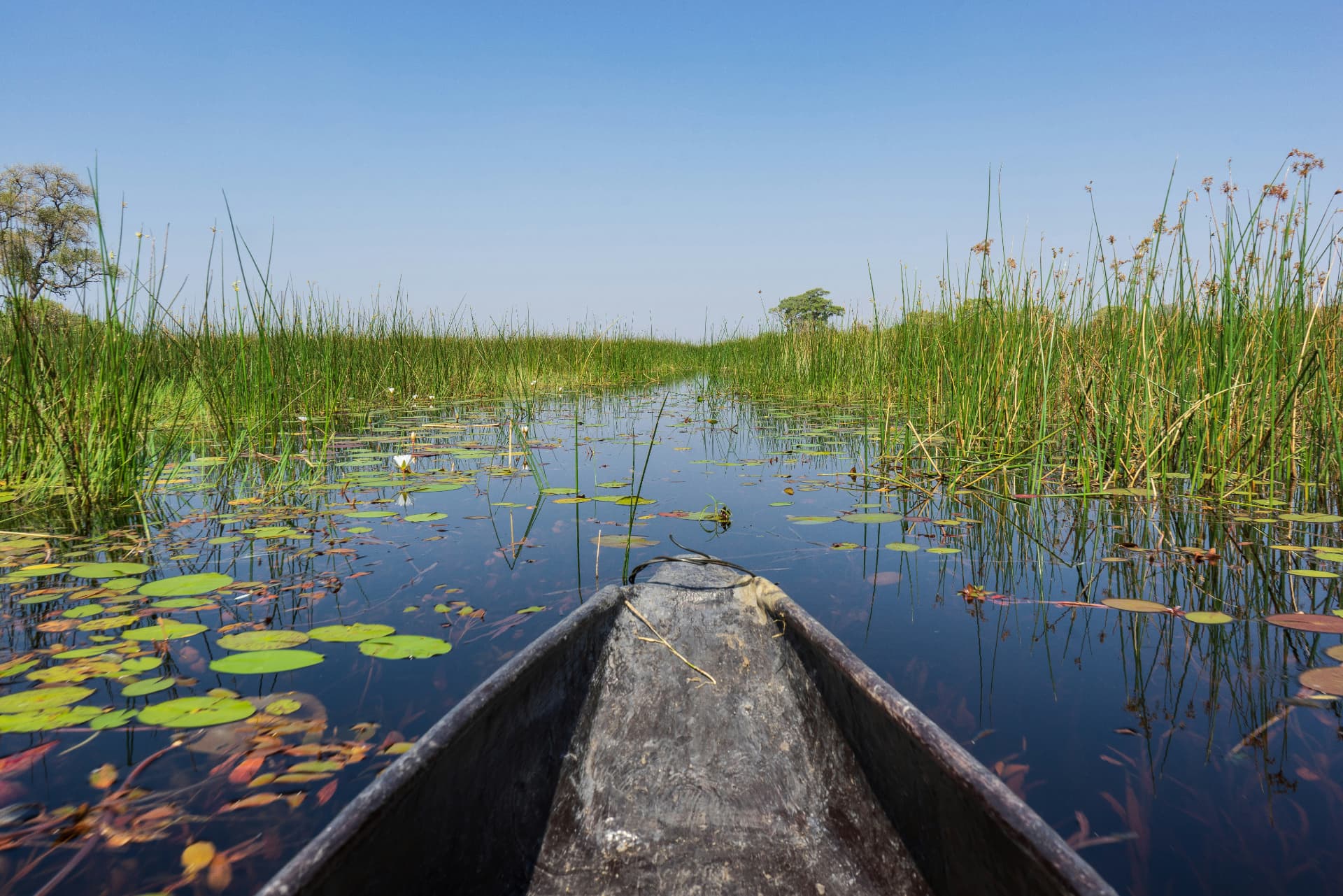
Everything follows from where a camp sits relative to the water. Water camps occupy islands on permanent lagoons: mokoro, the shallow dugout poled standing from the stern, motorboat cruises and short island walks. They are quiet, extraordinary at close range and light on big game — a morning may deliver sitatunga, red lechwe and a long bird list and no lion at all. Land camps sit on dry ground: drives morning and evening, walking on private concessions, and the predator viewing most clients came for. Chief's Island, a fault block over 70 kilometres long, carries the best-known addresses, Mombo and Chief's Camp among them.
Most clients want a land camp with water access, and a mokoro cannot be promised at every camp in every month. Water levels vary year to year; a camp that poled guests through lily beds in July may have dry channels by November. Two nights water and three land is the classic first-visit build; with only four, put them on land and treat a mokoro as a bonus.
Moremi — the public heart, and where its rules bite
Moremi covers just under 5,000 square kilometres along the eastern Delta, only about 30 per cent of it mainland, with close to 500 bird species and one of Africa's most closely studied wild dog populations, monitored since 1989. The game equals anything in the private concessions; what differs is what a guide may do. Inside Moremi, vehicles stay on designated tracks, there is no off-road driving to a sighting and no night driving, and self-drive and mobile operators share the roads, so a good leopard gathers traffic. On a concession the operator holds sole traversing rights, caps vehicle numbers, and may go off-road, drive at night and walk with an armed guide — two camps of eight tents on 400 square kilometres is a normal ratio. Sell Moremi to the value-conscious; sell a concession to anyone paying full rate, because that freedom is the product.
Chobe and the Linyanti — the same elephants, two different products
Protection of the Chobe was proposed in 1931, abandoned to tsetse control in 1943, revived as a game reserve in 1960 and declared Botswana's first national park in 1967. It runs to roughly 11,700 square kilometres and holds something like 50,000 elephants, the densest concentration of the Kalahari population anywhere. The riverfront in September and October is a genuine set piece, hundreds of elephant and buffalo coming down to drink before sunset, best watched from a boat. It is also ten minutes from Kasane airport, which means day visitors and a busy river: two nights at the start or end of a trip, not the centrepiece.
Inland the park changes entirely. Savuti sits on an old marsh fed by the Savute Channel, which stopped flowing in 1982, stayed dry for twenty-eight years and reached the marsh again in January 2010 for tectonic rather than meteorological reasons. West of it, the Linyanti, Selinda and Kwando concessions cover more than 4,000 square kilometres of private land, with the Selinda Spillway linking the Okavango and Linyanti systems in high-flood years. Dry-season elephant numbers rival Chobe's, wild dog denning runs June to August, and there is no one else on the road.
The Kalahari and the Makgadikgadi — the counterweight
The Central Kalahari Game Reserve was proclaimed in 1961 and covers 52,800 square kilometres, the second largest game reserve on earth. Deception Valley, a fossil river course formed around 16,000 years ago, greens after the December rains and draws springbok, gemsbok and the black-maned Kalahari lions behind them. It is a summer destination, and therefore the useful inverse of the Delta. Its history with the San, or Basarwa, should be described accurately rather than romantically: relocations from the mid-1990s were ruled unlawful by Botswana's High Court in 2006 and access rights remain contested.
North-east, the Makgadikgadi salt pans cover some 16,000 square kilometres, all that remains of a lake that once exceeded the area of Switzerland. Nxai Pan National Park holds Baines' Baobabs, painted by Thomas Baines on his 1861 crossing. Two zebra migrations run through: a 250-kilometre movement between the Delta and the Makgadikgadi grasslands, cut by a veterinary fence from 1968 until 2004 and resumed within three years of its removal, and a circuit of around 1,000 kilometres between the Chobe floodplains and Nxai Pan, identified only in 2012 and the longest terrestrial mammal migration in Africa. Add habituated meerkat colonies, quad bikes on the dry pan crust and no light pollution. The Delta is effectively malaria-free.
Combining with Victoria Falls — the standard finish
Kasane sits about 80 kilometres from Victoria Falls town and the road transfer via the Kazungula border takes roughly two hours with formalities. This is why most Botswana itineraries end at the Falls rather than back-tracking to Johannesburg: Maun to Kasane by light aircraft, two nights on the riverfront, then across. The Kazungula Bridge, opened in May 2021, carries traffic to Zambia and Livingstone. The Falls are a two-night stop, at their fullest March to May.