
What makes it special
Zambia
Walking safaris and camps that stay small.
Zambia is a country of rivers and its safari map is drawn by them. The plateau sits mostly between 1,000 and 1,400 metres, and three systems cut into it: the Zambezi along the southern border, the Kafue down the middle, and the Luangwa dropping through a rift valley in the east. In the north the land tips the other way into the Congo basin, where the Chambeshi rises and spreads into the Bangweulu swamps. Twenty national parks and thirty-four game management areas cover a large share of some 752,600 square kilometres, and most of them see almost nobody.
The territory was run by Cecil Rhodes's British South Africa Company from the 1890s, became the Crown colony of Northern Rhodesia in 1924 and took independence on 24 October 1964 under Kenneth Kaunda. Livingstone was the capital until 1935, when the seat moved to Lusaka, and what followed was a copper economy in which tourism stayed small and largely domestic for decades. That neglect is now the asset. The parks were never developed at scale, the road networks inside them were never built out, and bed numbers stayed low.
The other inheritance is a man. Norman Carr, born 19 July 1912 and dead on 1 April 1997, was a game ranger in the Luangwa who in 1950 went to Senior Chief Nsefu and proposed a reserve on tribal land with the takings going to the chief's people. The camp that opened there was the first public game-viewing camp in Northern Rhodesia, and the arrangement — community land, community revenue, cameras rather than rifles — predates the phrase community conservation by forty years. Carr took his guests out of the vehicle and walked them, and the commercial walking safari begins at that point. He was instrumental in the creation of Kafue as a national park in the 1950s, built Kapani on the Luangwa bank, founded the Kapani School Project in 1986 and wrote Valley of the Elephants in 1980 and Kakuli in 1996.
A walking party goes out with a licensed professional guide and an armed wildlife-police scout, six to eight guests at most, in single file, and the morning is built around tracks, birds, dung and trees rather than around clearing the Big Five from a vehicle by ten o'clock. Spotlit night drives are permitted here, which they are not in Kenya or in Tanzania's national parks. A handful of camps are genuinely luxurious, but nobody comes to Zambia for the bathrooms. This is a destination for the third or fourth safari, for photographers and for walkers. A first-timer who wants a swimming pool and a guaranteed leopard is better served in the Sabi Sand, and saying so early saves the file.
South Luangwa — the birthplace of the walking safari
South Luangwa runs to 9,050 square kilometres along the Luangwa River, set aside as a game reserve in 1938 and made a national park in 1972. The river is the whole story: it meanders hard across a flat valley floor, cuts a new course most flood seasons and abandons the old one, leaving a chain of oxbow lagoons behind it. Through the dry months those lagoons shrink and the game comes to them — more than 60 mammal species and over 400 birds, with hippo, buffalo and elephant in numbers on the riverbed itself. Leopard density is among the highest in Africa, and because night driving is legal the animal most clients want is the one Luangwa delivers best. Three subspecies live only in this valley: Thornicroft's giraffe, of which roughly 550 remain, Cookson's wildebeest and Crawshay's zebra.
The Mfuwe sector near the gate and the airstrip holds the all-weather lodges — brick, plumbed, open most of the year, the right first stop. Deeper in, reached on dirt, are the bush camps: four to eight beds in reed, thatch and canvas, rebuilt each dry season and taken down before the rains. Nsefu, in the sector Carr negotiated in 1950, is the oldest camp in the country. The standard sell is two camps in one park, three nights on the river and three walking between bush camps, and it is a better week than most clients expect.
The Lower Zambezi — canoes, tigerfish and the escarpment
Declared a national park in 1983, having been a presidential game reserve before that, the Lower Zambezi holds the north bank directly opposite Zimbabwe's Mana Pools. The Zambezi escarpment rises behind it and does the work of a fence, pushing elephant, buffalo, lion and wild dog down onto a narrow floodplain of winterthorn and mopane. It is the most varied park in Zambia for activities: game drives, walking, motorboat cruises among the islands, and canoeing the side channels, which puts guests at eye level with hippo and is not for the nervous. It is also the country's best tigerfishing water, catch and release, strongest from September to November.
Access is the second argument. The Jeki, Royal and Left Bank airstrips are around half an hour's flying from Lusaka, which makes this the easiest Zambian park to add to a short trip and the natural pairing with South Luangwa — valley and river, walk and canoe, one charter each way. The camps here are the most polished in the country and the park reads well for honeymoons.
Kafue and the Busanga Plains — scale, and a very short season
Kafue is Zambia's largest national park at roughly 22,400 square kilometres, larger than Wales and among the largest protected areas in Africa, set aside in the 1950s under Norman Carr. It is too big to sell as one place. The north-west corner, the Busanga Plains, carries the rates: seasonally flooded grassland along the Lufupa river that drains slowly from June into short-grass plain, with red lechwe, puku, roan and oribi on it, wattled crane overhead and Zambia's largest cheetah population working the open ground. The lions here are known for climbing trees, and balloon flights operate in season.
The catch is that Busanga is under water for much of the year. Its camps run roughly July to October and no longer — the shortest season of anything Zambia sells — and there are very few rooms. The southern sector, on the Kafue River near the Itezhi-Tezhi dam, is reachable by road from Lusaka in a few hours and works as a cheaper stay for a client who cannot fund the charter.
Liuwa Plain and Bangweulu
Liuwa Plain, 3,369 square kilometres of grassland in the far west measuring about 72 kilometres by 32, was protected in the early 1880s by Lubosi Lewanika, Litunga of the Lozi, as his hunting ground — one of the oldest protected areas on the continent. It became a national park in 1972 and has been managed since 2003 by African Parks with the wildlife department and the Barotse Royal Establishment. Tens of thousands of blue wildebeest gather and move across it, the second-largest wildebeest migration in Africa with almost nobody watching. This is also where Lady Liuwa lived, the lioness left alone on the plain after poaching took the rest, filmed by National Geographic in 2010 and dead in August 2017; lions were brought in around her and the population is re-established. King Lewanika Lodge is the only permanent camp.
Bangweulu in the north-east is a different proposition: 6,000 square kilometres under African Parks management since 2008 inside a wetland of 9,850, holding some 36,600 black lechwe, the last significant population of the subspecies. The draw is the shoebill, a metre-tall prehistoric stork that hunts lungfish in the papyrus and is very hard to see anywhere else, approached on foot and by mokoro as the floodwater drops. Between fifty and ninety thousand people live and fish inside the wetland, so this is a working landscape rather than an empty one. Both are fourth-safari destinations, both cost a charter, and the accommodation is comfortable rather than grand.
Kasanka — ten million bats
Kasanka is small, 390 square kilometres in Central Province, and in 1987 became the first Zambian national park handed to a private body to run, under the Kasanka Trust. For roughly six weeks from late October into December, close to ten million straw-coloured fruit bats crowd a few hectares of swamp forest inside it: reckoned the largest mammal migration on earth and the densest concentration of mammal biomass anywhere, with a dusk exodus that takes twenty minutes to pass overhead and raptors working the edges of it. The park also holds an estimated 500 to 1,000 sitatunga and is probably the most reliable place in the world to see one. The commercial point is the timing — this happens when most of the country is shut, which turns an unsellable month into a three-night specialist product.
Livingstone — the gateway, and the bookend
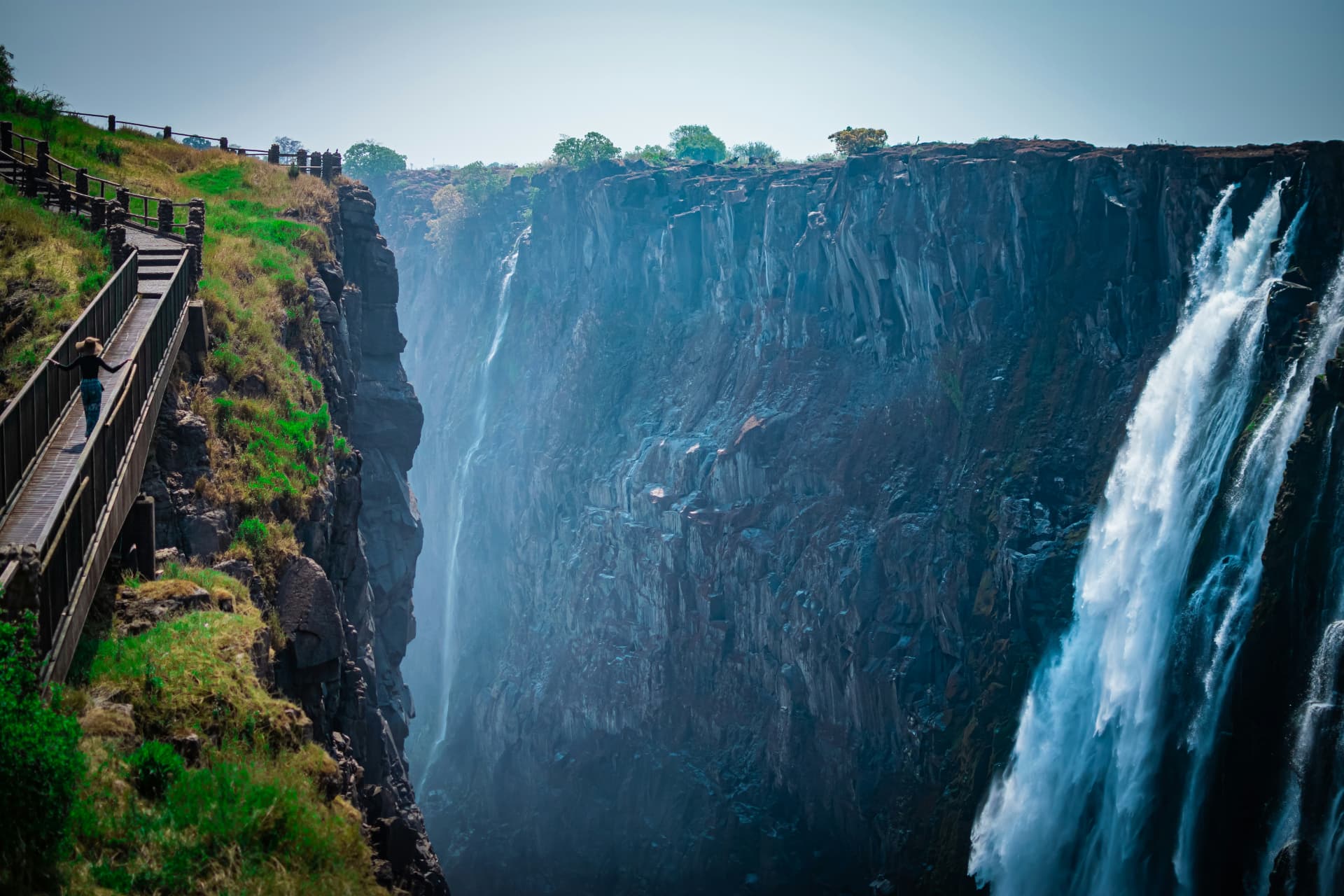
Victoria Falls has its own page in this collection and should be sold from there, including the choice of bank. What matters here is that Livingstone works as the front or back door to a Zambian itinerary. Harry Mwanga Nkumbula International (LVI) sits five kilometres from town, takes direct flights from Johannesburg as well as Lusaka, and puts clients an hour from the capital's connections north. Two nights on the upper Zambezi at one end of a safari is the standard shape: land, decompress on the river, fly to the game, and come back through for the falls before the long-haul out. What Livingstone is not is the body of a Zambia trip. A client who spends a week here has bought activities rather than a country.