
What makes it special
Kenya & Masai Mara
Open plains and predator density that rewards patience.
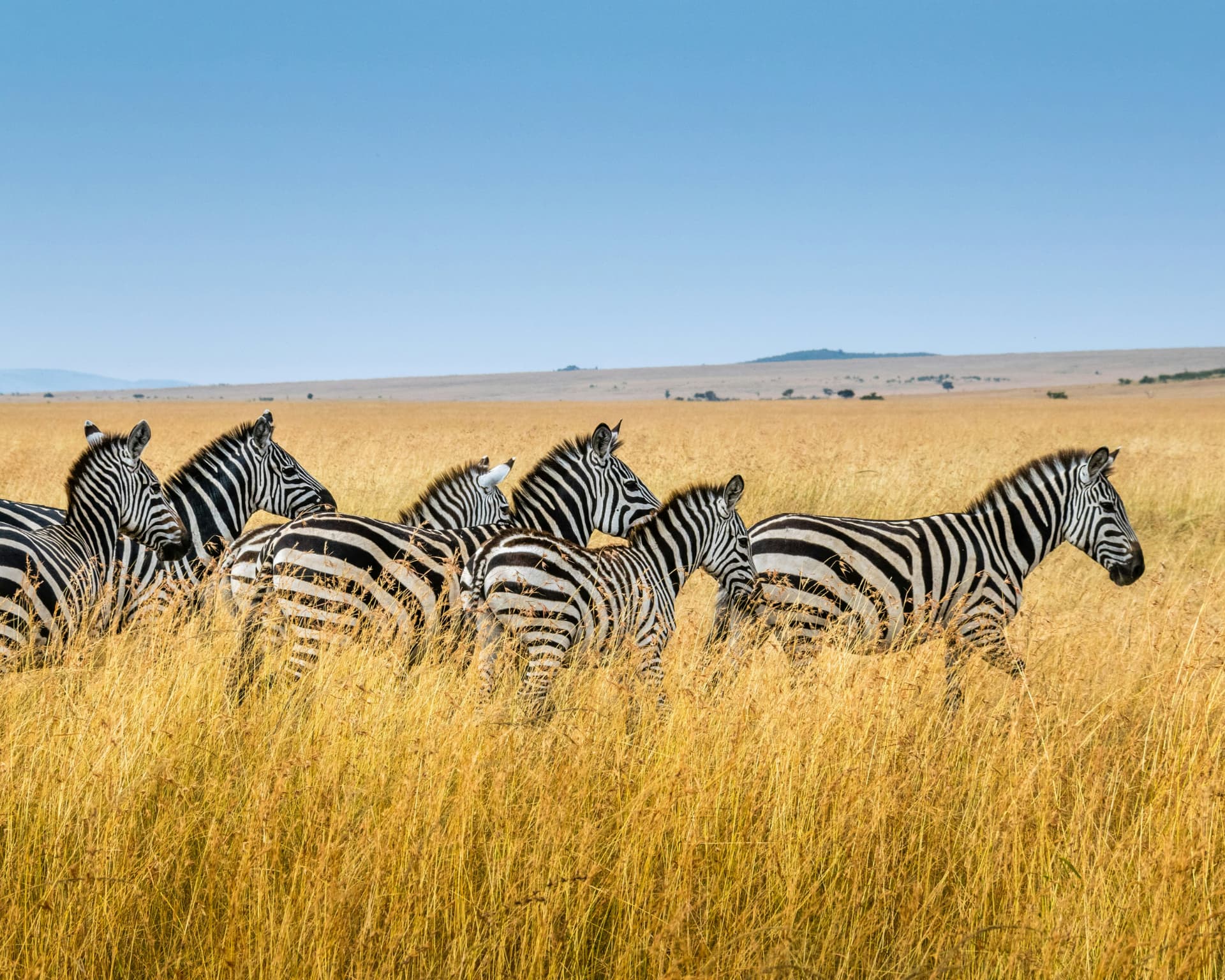
The Masai Mara is the northern end of an ecosystem that ignores the border drawn across it: 1,510 square kilometres in Narok County, 224 kilometres west of Nairobi, bounded west by the Oloololo escarpment and south by the Serengeti, into which it opens unfenced. Through it move roughly 1.3 million wildebeest, 200,000 zebra and 500,000 Thomson's gazelle, and behind them the highest densities of lion, cheetah and spotted hyena on the continent.
It was set aside as a 520-square-kilometre sanctuary in 1961, extended the same year to 1,821 square kilometres and cut back three times between 1974 and 1984. Two consequences matter commercially. It is administered by Narok County, not the Kenya Wildlife Service, so fees and rules are set locally and change without notice; and the western third, the Mara Triangle, has been run since the early 2000s by the not-for-profit Mara Conservancy, with better roads and fewer vehicles.
Kenya banned sport hunting in 1977, a decade before its neighbours, and built its industry on photography. That produced habituated animals and a deep guiding tradition, and a conservation funding gap the conservancies now fill. Beyond the Mara, Kenya offers more variety inside a two-hour flight radius than anywhere in Africa: elephants under Kilimanjaro, rhino on the Laikipia plateau, an arid northern fauna at Samburu, a Swahili coast with seven centuries of trade behind it.
The Masai Mara National Reserve — the set piece, and the honest caveat
The crossings are why clients ask for Kenya. Herds arrive from the Serengeti from roughly July, mass on the Mara and Talek rivers through August and September and drift south from October, though timing follows rainfall and no one can promise a crossing on a given date. It is also, in those months, busy: off-road driving is prohibited, and a client can find thirty vehicles at a crossing point waiting for a herd that never commits.
The Mara conservancies — it is unique
Ringing the reserve north and east are community conservancies on Maasai group-ranch land subdivided into individual title from the 1990s. Landowners lease their parcels, take a fixed rent per acre paid monthly whether or not tourists come, and keep regulated grazing rights; partners build a few camps against a capped bed count. Mara North covers about 29,170 hectares across 783 landowners, established 2009; Mara Naboisho over 22,500 hectares and 636 landowners; Olare Motorogi some 15,200 hectares from 288; Mara Lemek 7,021 from 350. Ol Kinyei was among the earliest.
The commercial argument is easy. Olare Motorogi caps itself at 94 beds and roughly one vehicle per 2,100 acres. Guests drive off-road to a sighting, go out at night, walk with an armed guide and sit at a leopard alone. Rates carry a conservancy fee of roughly 100 to 130 US dollars per person per night on top of the bed night, so a conservancy camp lands materially above a reserve lodge of the same standard. The reserve holds the herds; the conservancies hold the space.
Laikipia and Samburu — rhino, and the north
The Laikipia plateau north-west of Mount Kenya covers about 9,500 square kilometres of former colonial cattle ranches turned over to wildlife, with more than 4,100 square kilometres under some 32 conservancies and no national park among them. It holds close to half of Kenya's black rhino. Ol Pejeta, 360 square kilometres west of Nanyuki, keeps Najin and Fatu, the last two northern white rhinos alive, moved from a Czech zoo in December 2009. Lewa, established 1995 on a sanctuary the Craig family fenced in 1983, carries the world's largest population of Grevy's zebra and was inscribed by UNESCO in 2013 as an extension of the Mount Kenya World Heritage Site. Borana adjoins it; Segera and Loisaba lie west. Private land means riding, walking and rhino tracking on foot: the honeymoon and repeat-client answer.
North again, across the Ewaso Ng'iro, Samburu and Buffalo Springs are small — Samburu itself is 165 square kilometres — hot, and unlike anywhere else on a Kenyan itinerary. Doum palms and red rock replace grassland, and the fauna changes with them: Grevy's zebra, reticulated giraffe, Beisa oryx, gerenuk and Somali ostrich, the Samburu Special Five.
Amboseli and the Chyulu Hills — Kilimanjaro, and the elephants
Amboseli is 392 square kilometres of dust, pan and spring-fed swamp at the foot of Kilimanjaro, gazetted a national park in 1974 at the core of an 8,000-square-kilometre ecosystem. The mountain is usually clear only at dawn and dusk. The elephants are the substance: Cynthia Moss and Harvey Croze began work here in 1972 and have since followed more than 2,000 individually known animals. It is one of the few places left with big tuskers.
Immediately east, the Chyulu Hills are a volcanic field 100 kilometres long rising to 2,188 metres, gazetted a park in 1983. Green, high and cool, and bordered by group-ranch land where riding and walking are permitted, they give the same Kilimanjaro view with a fraction of the traffic. Base here, day-trip into Amboseli.
The coast and the Lamu Archipelago — where the safari ends
Lamu Old Town is the oldest and best-preserved Swahili settlement in East Africa, founded around 1370, blockaded by the Portuguese under Tristao da Cunha in 1506 and at its height as an Omani protectorate through the eighteenth century; UNESCO inscribed it in 2001. There are no cars — donkeys and boats do the work — and most clients stay at Shela or on Manda across the channel. For a straight beach finish, Diani south of Mombasa has the best sand and shortest transfer; Watamu, on a marine national park, is the diving choice.
Nairobi — a stopover with a reason to stay
Clients will spend a night here whether they intend to or not, so give it a purpose. Nairobi National Park, gazetted 1946 as Kenya's first, is 117 square kilometres of open plain seven kilometres from the centre. The Sheldrick Wildlife Trust's orphanage sits inside it, founded in 1977 by Daphne Sheldrick for her late husband David, founding warden of Tsavo East, and opens one hour a day. Giraffe Manor, built in 1932 to a Scottish shooting-lodge design, has twelve rooms and books further ahead than almost anything in Africa. Karen Blixen farmed coffee below the Ngong Hills from 1913 to 1931 and published Out of Africa in 1937.