
What makes it special
Cape Town & Winelands
City. Ocean. Wine. Extraordinary food.
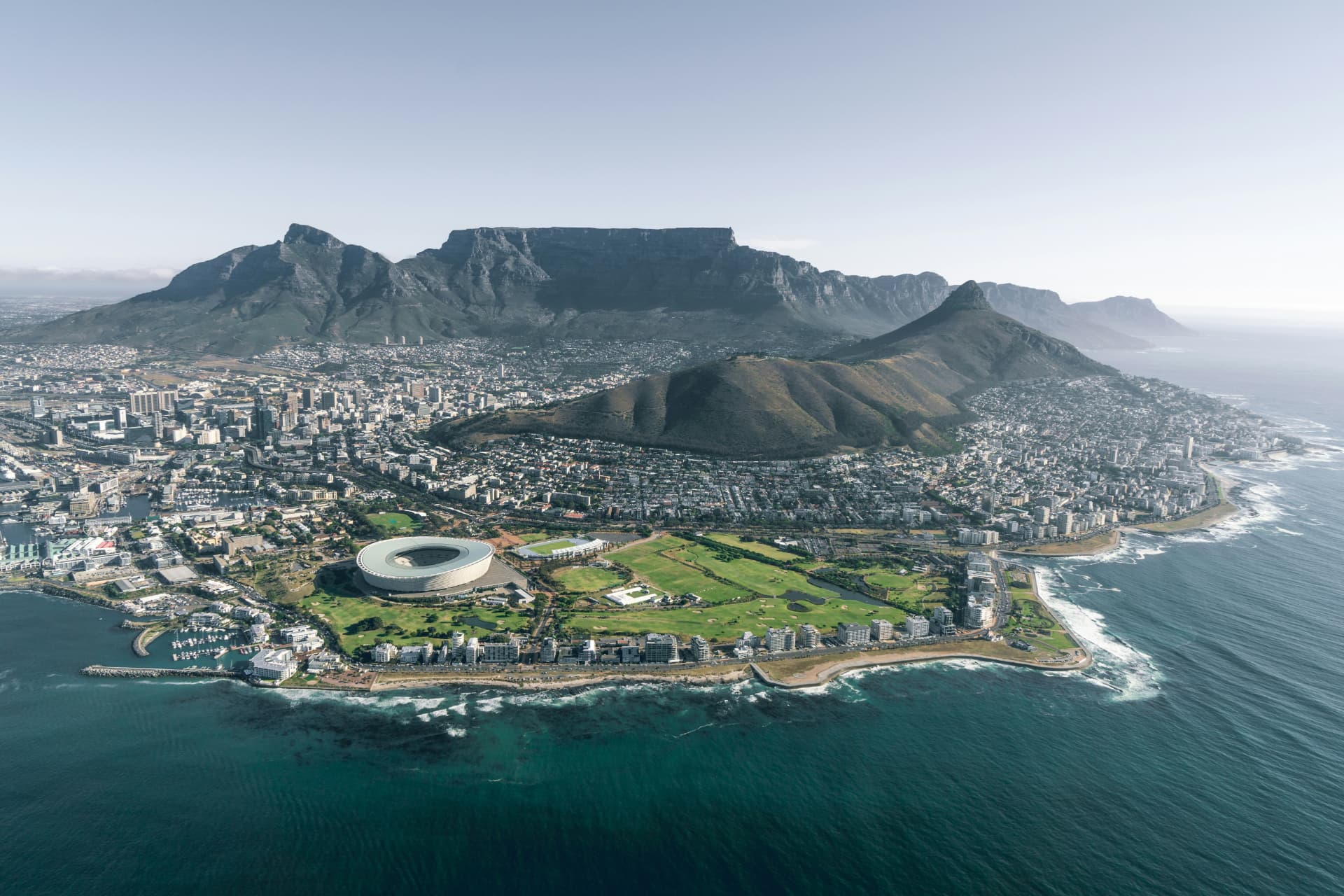
Few cities open with a view like this one. Table Mountain rises 1,086 metres straight out of the Atlantic, flat-topped and often draped in cloud, and beneath it Cape Town spreads across a peninsula where two oceans meet. It is one of the oldest mountains on earth, and the fynbos covering it belongs to the Cape Floral Kingdom — the smallest and most botanically dense of the world's six floral kingdoms, a UNESCO World Heritage Site holding more plant species on this one mountain than exist in the whole of the United Kingdom.
The city's story begins in 1652, when the Dutch East India Company established a refreshment station here to resupply ships rounding the Cape on the spice route. Vines followed almost immediately — the first Cape wine was pressed in 1659. That single decision, made to combat scurvy on the passage to Batavia, seeded what is now one of the oldest wine cultures outside Europe and the reason this destination sells as more than a city break.
The layered history sits alongside a harder one, and guests who want the real Cape should get all of it. Robben Island, visible from the waterfront, held Nelson Mandela for eighteen years. The District Six Museum records the forced removal of some 60,000 residents under apartheid. The painted houses of Bo-Kaap trace the Cape Malay community brought here as slaves and political exiles.
In the city itself, Zeitz MOCAA — the largest museum of contemporary African art, carved out of a 1920s grain silo — anchors the V&A Waterfront. Kirstenbosch ranks among the finest botanical gardens anywhere. The Cape Peninsula drive takes in Chapman's Peak, the Cape of Good Hope and the penguin colony at Boulders Beach in a single day. But the reason guests extend from five nights to ten lies inland and along the coast, in five distinct wine districts, each with its own character, cuisine and reason to stay.
Constantia — where it all started
Fifteen minutes from the city centre, on the cool eastern slopes of the Constantiaberg, sits the oldest wine-producing region in the southern hemisphere. Simon van der Stel founded Groot Constantia in 1685 and Steenberg was farmed from 1682 by Catharina Ustings, a remarkable figure who outlived four husbands and ran the estate herself. By the eighteenth century, Constantia's sweet Vin de Constance was ordered by the courts of Europe, name-checked by Jane Austen and Baudelaire, and Napoleon — exiled on St Helena — is said to have called for it on his deathbed. The wine died out with phylloxera and was resurrected at Klein Constantia in 1986; it is still made today, and pouring it is one of the great set-pieces of a Cape itinerary.
The modern draw is cool-climate white wine — Constantia sauvignon blanc and semillon are among South Africa's best, shaped by sea air off False Bay. Groot Constantia, Klein Constantia, Steenberg, Buitenverwachting and Constantia Glen all sit within a few minutes of one another, wrapped in oak avenues and gabled Cape Dutch manor houses. For guests who want vineyards without leaving the city, this is the answer.
Stellenbosch — the heartland
Founded in 1679 and named after Simon van der Stel, Stellenbosch is the second-oldest European settlement in South Africa and the undisputed capital of the Winelands. Some 200 estates surround a compact town of whitewashed Cape Dutch, Georgian and Victorian buildings, with Dorp Street lined by oaks planted three centuries ago. A major university keeps the cafés, galleries and restaurants genuinely alive rather than merely picturesque — an important distinction for guests staying several nights.
This is red wine country. The so-called Golden Triangle between the Simonsberg, the Helderberg and Stellenbosch Mountain produces the country's benchmark cabernet sauvignon and Bordeaux blends, alongside serious old-vine chenin blanc and increasingly good syrah. Kanonkop, Meerlust, Rust en Vrede, Jordan and Waterford are the names collectors know; Delaire Graff and Tokara, both set high on the Helshoogte Pass, pair cellar-door tastings with art collections, spas and some of the best views and cooking in the region. Stellenbosch is where a wine-serious client should sleep.
Franschhoek — the French corner
In 1688, French Huguenots fleeing religious persecution were settled by the Dutch in a narrow, mountain-ringed valley they named Franschhoek. They arrived with viticultural skill and vine cuttings, and their surnames — de Villiers, Malan, Joubert, du Toit — still run through South African wine. The Huguenot Memorial Monument at the head of the valley marks the story.
Today Franschhoek is the prettiest and most polished of the districts, and South Africa's acknowledged gourmet capital: a single main street carrying a density of high-end restaurants that few towns of 20,000 people anywhere can match, several of them in international rankings. Estates such as Boschendal, La Motte, Babylonstoren, Mont Rochelle and Le Lude — the latter for méthode cap classique, the Cape's traditional-method sparkling — combine cellar doors with destination dining, gardens and luxury lodging. The Franschhoek Wine Tram, a hop-on open-sided tram-and-bus loop between estates, is a genuinely charming way to spend a day and solves the drink-driving problem elegantly. If the brief is romance, honeymoon or a food-led stay, Franschhoek is the answer.
Paarl — granite, reds and brandy
Paarl takes its name from the great granite domes above the town, which glisten like pearls after rain — noted by the explorer Abraham Gabbema in 1657, with the settlement following in 1687. It is the largest of the Winelands towns and the least manicured, which for some guests is precisely the appeal: working farms, wide streets, and a sense that agriculture rather than tourism still sets the rhythm.
The wines lean red and generous — the warmer inland climate suits shiraz, cabernet and Rhône-style blends. Fairview is famous for pairing its wines with its own goat's cheese, Avondale farms organically and biodynamically, and KWV — the historic cooperative founded here in 1918 — offers brandy and chocolate tastings in a cathedral-scale cellar. Paarl also carries real historical weight: Nelson Mandela walked free from Victor Verster Prison just outside town on 11 February 1990, and the Afrikaans Language Monument on the mountainside above is one of the more unusual pieces of architecture in the country. Paarl works well as a day from Stellenbosch or Franschhoek rather than a base.
Hermanus & the Hemel-en-Aarde Valley — the cool coast
Ninety minutes from Cape Town along one of the world's great coastal drives, Hermanus is where wine and whales meet. Strictly speaking this is Walker Bay on the Cape South Coast rather than the Winelands proper, but no serious Cape itinerary should leave it out.
The Hemel-en-Aarde Valley — "heaven and earth" — is South Africa's answer to Burgundy. Tim Hamilton Russell planted here in 1975 in the belief that this cool, maritime, south-facing pocket could grow world-class pinot noir and chardonnay; the first vintage followed in 1981 and he was proved right. The valley now splits into three wards — Hemel-en-Aarde Valley, Upper Hemel-en-Aarde Valley and Hemel-en-Aarde Ridge — each with distinct soils and expression, and producers including Hamilton Russell, Bouchard Finlayson, Creation, Ataraxia, Newton Johnson and Storm draw wine travellers specifically. Chardonnay and pinot noir account for over half of all plantings.
Hermanus itself is widely considered the best land-based whale watching on earth. Southern right whales come into Walker Bay to calve between June and December, and from the Cliff Path they can be watched breaching a few dozen metres offshore — no boat required. The town keeps a whale crier who walks the front sounding a kelp horn to announce sightings. The combination of that and the Hemel-en-Aarde cellars makes an exceptional two-night extension.